Follow



While standard volcanic eruptions can alter local landscapes and disrupt regional aviation, supervolcanoes represent an entirely different scale of planetary mechanism. These are not merely enlarged versions of typical conical volcanoes; they are massive, complex crustal systems capable of generating eruptions that fundamentally alter global climate and ecosystems. To understand supervolcanoes, geologists look beyond traditional volcanic morphology to examine massive magma reservoirs, the mechanics of structural collapse, and the specific thresholds of the Volcanic Explosivity Index (VEI).
The term "supervolcano" is formally defined by the volume of material erupted during a single explosive event. According to the U.S. Geological Survey (USGS) and the broader vulcanological community, a supervolcano is a volcanic center that has experienced at least one eruption ejecting more than 1,000 cubic kilometers (240 cubic miles) of bulk volcanic material (tephra, ash, and pumice).
This places these events at the maximum level—VEI 8—on the Volcanic Explosivity Index. The index is logarithmic, meaning each step represents a tenfold increase in erupted volume. A VEI 8 eruption is ten times larger than a VEI 7 event (such as the 1815 eruption of Mount Tambora) and thousands of times larger than typical historical eruptions.
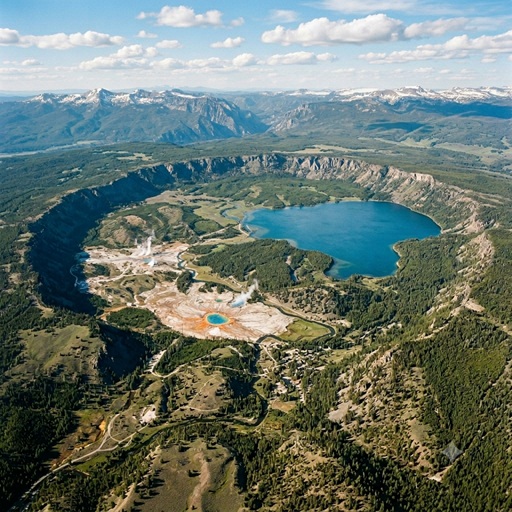
A common misconception is that a supervolcano is a towering mountain. In reality, most supervolcanoes lack a visible cone. Because of the sheer volume of magma involved, the primary structural feature of a supervolcano is a caldera—a vast, basin-like depression formed when the ground collapses.
During a super-eruption, an immense volume of magma is evacuated from a shallow chamber over a relatively short period. The weight of the overlying crust becomes unsupported by the suddenly emptied reservoir, causing the roof of the chamber to fracture and plunge downward. The resulting depression can span tens of kilometers in diameter. Over millennia, these calderas often fill with water, forming large lakes, or become obscured by subsequent low-viscosity lava flows and tectonic activity.
The genesis of a supervolcano requires a specific set of geological conditions that allow immense volumes of magma to accumulate in the upper crust without leaking away in smaller, frequent eruptions.
Supervolcanoes are predominantly associated with rhyolitic or dacitic magmas. These magmas possess a high silica content (frequently exceeding 70%). Silica molecules readily polymerize into long chains, which creates a highly viscous, sticky melt that resists lateral flow. Instead of erupting easily upon reaching the upper crust, the magma remains trapped, slowly growing into a massive underground reservoir.
The driving force behind the explosivity of a supervolcano is its volatile content—primarily dissolved gases such as water vapor (H₂O), carbon dioxide (CO₂), and sulfur dioxide (SO₂). As fresh, hot basaltic magma from the mantle melts the surrounding continental crust, it injects these volatiles into the evolving rhyolitic reservoir.
Because the magma is too viscous to escape through narrow vents, it remains sealed beneath kilometers of rock. The system builds pressure via two main mechanisms:
When the roof rocks finally fail, a catastrophic decompression chain reaction occurs. The dissolved gases rapidly exsolve and expand explosively, fragmenting the viscous liquid magma into microscopic shards of volcanic ash and pumice, which are violently expelled into the atmosphere.
Occurring approximately 74,000 years ago, the Youngest Toba Tuff (YTT) eruption is the largest known volcanic event of the Quaternary period. It erupted an estimated 2,800 cubic kilometers of material. The eruption formed a massive 100 x 30 km caldera that is now home to Lake Toba. The sheer volume of sulfur aerosols injected into the stratosphere caused a significant global cooling event.
The Taupō volcanic center has produced multiple high-index events. Its Oruanui eruption, occurring roughly 26,500 years ago, is the world's most recent VEI 8 super-eruption, ejecting approximately 1,170 cubic kilometers of material. The modern Lake Taupō occupies the massive caldera created during this structural collapse.
The Yellowstone hotspot track has produced three major caldera-forming eruptions over the past 2.1 million years. The largest of these, the Huckleberry Ridge eruption (2.1 million years ago), ejected roughly 2,450 cubic kilometers of material. The most recent caldera-forming event, the Lava Creek eruption (640,000 years ago), created the current 70 x 45 km caldera system. Today, the system remains active, manifested by intense geothermal activity and ongoing seismic swarms driven by a deep crustal magmatic plumbing system.
The primary global consequence of a super-eruption is not the immediate blast or local pyroclastic flows, but the atmospheric injection of fine ash and sulfur dioxide (SO₂).
While heavy ash particles fall out of the atmosphere within days to weeks, sulfur dioxide reacts with water vapor in the stratosphere to form highly reflective sulfate aerosols. These aerosols circulate globally, reflecting incoming solar radiation back into space. This process induces what is geologically termed a "volcanic winter," characterized by a drop in global mean surface temperatures that can persist for years, severely impacting global vegetation and hydrological cycles.
Supervolcanoes represent some of the most powerful natural mechanisms on Earth. Their existence is governed by the slow, covert accumulation of highly viscous, volatile-rich magma over tens of thousands of years, culminating in catastrophic caldera collapse. By studying the geochemical footprints of past events and maintaining sophisticated seismic, geodetic, and hydrothermal monitoring networks, the global scientific community continues to map the deep-seated plumbing systems that drive these extraordinary geological phenomena.